New Forest Pony
One of the nine British native breeds, running semi-wild on the New Forest for a thousand…
The riding pony of the four Welsh sections: up to 13.2hh, finer than a Section A and bred to be ridden by children. Athletic, hardy and sensible, and the classic first competition pony.
We do not have enough Welsh Section B adverts yet to publish a price range from our own data. The figures in the price section below are an editorial estimate.
Scores are editorial, and describe the breed in general. Individual animals vary, and how a dog is bred and raised matters more than its breed.
Ask to see the certificates, with the parents' registered names on them. "Parents health tested" in an advert means nothing on its own.
The Welsh Pony proper: the second of the four sections in the Welsh Pony and Cob Society stud book, not exceeding 13.2 hands (137cm). Finer and more riding-shaped than the Section A mountain pony, with more length of rein and a longer stride.
Where a Section A is a child's first pony, a Section B is the one they compete on.
Created deliberately in the early 20th century by putting Section A mares to small Thoroughbred and Arab stallions to produce a quality riding pony that kept the hardiness of the hill stock. The stallion Tan-y-Bwlch Berwyn, by an Arab out of a Welsh mare, is the foundation of the modern type.
The section was formalised in the stud book in 1931.
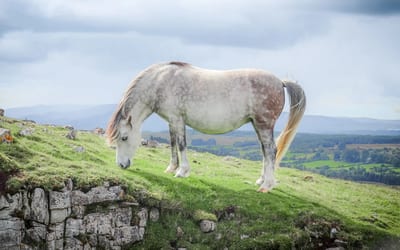
122-137cm. A refined head with a slightly dished face, a well-set neck, sloping shoulder and a level topline. More scope and more daylight underneath than a Section A.
Any solid colour - grey, bay, chestnut, black, dun, roan, cream - but never piebald or skewbald, which is a useful check against a mislabelled advert.
Sensible and willing, with more forward than a Section A and less independence. They are alert and quick to learn, and a well-produced one is honest across country and in the ring.
They are still Welsh: clever, opinionated and perfectly capable of teaching a child bad habits if the child is left to it.
Highly trainable and fast to pick things up, which cuts both ways. They learn a course quickly and they learn evasions just as quickly. Consistent handling from somebody competent is what makes the difference.
The classic children's competition pony. Match the pony's education to the child's rather than its height to the child's - a competent ten-year-old on a schoolmaster Section B is a fine partnership; a novice on a green four-year-old is not.
Lives happily out in company and is generally sensible around farm dogs.
Hardy, and the problems are the native ones.
Laminitis. The main risk. Welsh ponies are efficient on poor grazing and UK pasture is, from their point of view, a permanent feast. Most need restricted grazing, a track system or a muzzle.
Equine Metabolic Syndrome and PPID (Cushing's), common in natives and often first noticed as recurrent laminitis. Both testable on a blood sample.
Sweet itch, an allergic reaction to midge bites - seasonal, miserable and manageable with rugs rather than curable.
Dental problems in old age, because they live long enough for their teeth to run out.
Daily checks year round: water, fencing, feet, and a hands-on look for injuries. Feet picked out daily, farrier every six to eight weeks, worm counts four times a year, teeth annually, vaccinations annually. Most live out with a field shelter.
Budget an hour a day, more in winter.
A thick winter coat that sheds heavily in spring. Do not clip a pony living out unless you will rug it properly. Manes and tails left long and unpulled for showing. Mud fever and rain scald are the routine winter jobs.
Ridden work three to five times a week suits most, and they will do a great deal more. They event, jump, do dressage and go in the showing ring, and they hack out sensibly.
Less than you think. Most need no hard feed beyond a vitamin and mineral balancer, plus hay in winter, soaked if weight is a problem. Overfeeding is the commonest mistake made with Welsh ponies and it is not a kindness.
£2,000-£6,000 for a sound, well-schooled pony, and £8,000-£20,000+ for a proven show or competition animal with a record. Unbroken youngstock from £1,000.
Keeping one costs £2,500-£6,000 a year at DIY livery, more on part or full.
Ask for the passport at the first viewing and check the microchip matches it - a legal requirement and a hard stop if missing.
Have the child who will ride the pony ride it, and see it caught from the field rather than tacked up and waiting.
Get a five-stage pre-purchase vetting from your own vet, £250-£450, and ask specifically about laminitis history. Look at the feet for the divergent growth rings that follow a founder.
No Welsh Section Bs are advertised at the moment. Save this search and an email goes out when one is listed.
A shortlist rarely has one name on it. These sit closest to the Welsh Section B on size, coat and temperament, and each one has a full guide.
Going to see a Welsh Section B? Take the horse and pony checklist with you. It is the questions worth asking while you are stood in somebody's kitchen, rather than on the drive home.