French Lop
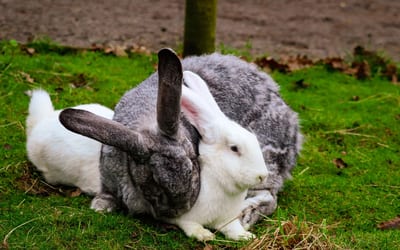
A large lop of 4.5-6.8kg, heavy-boned and famously docile. Genuinely the size of a small…
The oldest domestic rabbit breed and the one with the longest ears of any animal, spanning up to 80cm tip to tip. Sweet-natured and calm, and the ears themselves need daily management.
We do not have enough English Lop adverts yet to publish a price range from our own data. The figures in the price section below are an editorial estimate.
Scores are editorial, and describe the breed in general. Individual animals vary, and how a dog is bred and raised matters more than its breed.
Ask to see the certificates, with the parents' registered names on them. "Parents health tested" in an advert means nothing on its own.
A large rabbit of 4.5-5.5kg whose ears are the longest of any animal relative to body size - a minimum of 53cm tip to tip for showing, and records over 80cm. The ears trail on the ground when the rabbit moves.
They are the oldest of the fancy rabbit breeds and the origin of every other lop.
Developed in England in the early 19th century, and the first rabbit bred purely for appearance rather than for meat or fur. Victorian fanciers competed on ear length, keeping rabbits in heated buildings because warmth encourages the ears to grow.
Every other lop breed descends from them: the French Lop, and through it the Dwarf and Miniature Lops.
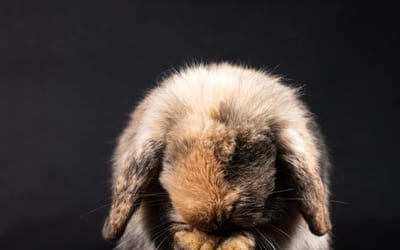
4.5-5.5kg, 30-40cm. A mandolin-shaped body, a broad head and the ears, which should be wide and thick as well as long, hanging vertically either side of the head.
Short dense coat in solid and broken patterns.
Exceptionally docile and people-oriented, often described as the most laid-back of all rabbit breeds. They are slow-moving, tolerant and often enjoy company more actively than most rabbits.
They are also, because of the ears, more dependent on their keeper than any other breed.
Litter-train well and learn routines. They are calm enough to handle easily, though as with any large rabbit the handling must support the whole body.
Good with supervised older children, and their placidity is genuine. Small children must be taught never to touch or pull the ears, which is harder than it sounds because the ears are the thing everybody wants to touch.
Keep in a neutered pair with the space to match. Never with a guinea pig.
Ear injuries and infections. The defining issue. The ears drag on the ground, get trodden on by the rabbit itself, catch on enclosure fittings, split, and pick up dirt. Sores, frostbite in winter and fly eggs in summer all start here.
They also regulate temperature through the ears, so heat and cold both affect them more than other rabbits.
Sore hocks and arthritis, from the size and weight.
Dental disease, gut stasis, myxomatosis and RHDV1/RHDV2, flystrike and E. cuniculi, as for any rabbit.
Five to nine years.
Inspect the ears every day, along their whole length and inside, for splits, sores, dirt and fly eggs. Keep bedding scrupulously clean and deep, because the ears sit in it. Trim nails regularly so the rabbit does not scratch its own ears.
Full-body check including feet and bottom, twice daily in warm weather.
Coat is easy - a weekly brush. The ears are the work: wiped clean, dried, and checked. Never bathe the rabbit.
A large permanent space with no fittings the ears can catch on - no wire mesh floors, no gaps, nothing at ear height to snag. Flat, soft, clean flooring throughout.
They are not fast or athletic and are happy with room to move rather than to sprint.
85% hay, unlimited, with bowls shallow and wide enough that the ears do not trail in food or water. Daily greens and a measured portion of pellets. No muesli.
£60-£150. Less commonly bred than the smaller lops, so expect to travel.
Setup £600-£1,500 for a large, safe, flat-floored enclosure. Running costs £1,200-£2,000 a year for a pair.
Look at the ears of the parents and of the kit: they should be clean, unbroken, with no scabs, splits or crusting at the edges.
Ask what the rabbits are housed on and look at it. Wire, mesh or a small hutch tells you the breeder has not thought about the one thing this breed needs.
Check feet, teeth and the back end. Do not buy under eight weeks, and ask for the vaccination record.
Then be realistic: this is a beautiful, gentle rabbit that needs a daily ear inspection for its whole life, and it is not a beginner's animal.
No English Lops are advertised at the moment. Save this search and an email goes out when one is listed.
A shortlist rarely has one name on it. These sit closest to the English Lop on size, coat and temperament, and each one has a full guide.
Going to see a English Lop? Take the rabbit checklist with you. It is the questions worth asking while you are stood in somebody's kitchen, rather than on the drive home.