Dwarf Lop
A medium lop of 1.9-2.4kg, larger than a Holland and smaller than a French. Placid, sturdy…
Britain's most popular pet rabbit: a compact lop-eared breed with a deservedly gentle reputation. The lop ear is the appeal and also the source of the breed's two main health problems.

We do not have enough Mini Lop adverts yet to publish a price range from our own data. The figures in the price section below are an editorial estimate.
Scores are editorial, and describe the breed in general. Individual animals vary, and how a dog is bred and raised matters more than its breed.
Ask to see the certificates, with the parents' registered names on them. "Parents health tested" in an advert means nothing on its own.
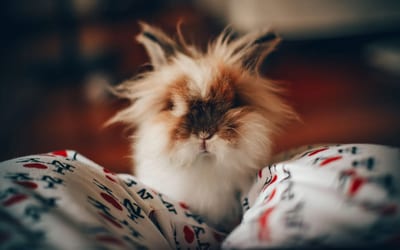
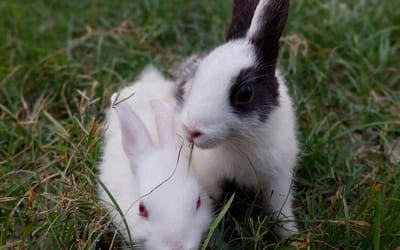
A small lop-eared rabbit weighing 1.4-2kg, with ears that hang either side of the head rather than standing upright. Compact, muscular and round, with a broad head and a dense short coat in a wide range of colours.
British naming is confusing here. What is sold in the UK as a "Mini Lop" is usually the breed the British Rabbit Council calls a Dwarf Lop; the BRC's own Mini Lop is smaller again. In practice the adverts use the terms interchangeably, so ask for the weight.
Descended from the French Lop, itself developed in nineteenth-century France from the English Lop and the Flemish Giant. German breeders produced a smaller version, the Klein Widder, in the 1950s, which reached Britain as the Dwarf Lop. The Mini Lop as such was recognised in the United States in 1980. They have been the most popular pet rabbit in Britain for years.
1.4-2kg. Thickset and rounded, with a broad flat-topped head, a well-developed crown at the base of the ears, and ears hanging close to the cheeks. The coat is short, dense and glossy.
The reason for the popularity. Mini Lops are typically calm, tolerant and sociable - noticeably easier to handle than most upright-eared breeds. They enjoy company, settle quickly, and many actively seek out attention.
One caution: rabbits communicate with their ears, and a lop cannot. You lose one of the clearest signals that a rabbit is frightened or annoyed, so you have to read body position and thumping instead.
Very trainable by rabbit standards. They litter-train quickly, learn routines, and respond well to clicker training. Food-motivated and patient, which makes them a good choice for a family that wants to interact with the animal rather than just look at it.
The best common breed for a family with children, with the usual conditions: supervised handling, sitting on the floor, and never chasing or grabbing. They are solid enough to be held safely in a way a Netherland Dwarf is not.
Keep them in a neutered pair. A single rabbit, however much attention it gets from people, is a lonely animal - and a bonded pair is less work, not more. Never house a rabbit with a guinea pig.
Ear infections. The defining lop problem. Folded ear canals do not drain, so wax accumulates and infection follows. Signs are head shaking, scratching, a head tilt or a bad smell. Chronic cases need long-term veterinary management. Check inside the ears monthly.
Dental disease. The shortened skull that produces the lop head also crowds the teeth. Malocclusion, molar spurs and root abscesses are all common, and molar problems cannot be seen without a vet's examination.
Gut stasis - a rabbit that stops eating or passing droppings needs a vet the same day.
Myxomatosis and RHDV1/RHDV2 - all usually fatal, all vaccine-preventable, and indoor rabbits are still at risk.
Flystrike in summer, and E. cuniculi.
Unlimited hay topped up, water checked twice, litter tray cleaned, back end checked - twice daily in warm weather. Ears checked monthly, nails every six to eight weeks, annual vaccination, and a rabbit-competent vet identified before you need one.
Weekly brushing, more during a moult. Never bathe. Nails need clipping regularly because a house rabbit does not wear them down.
At least 3m x 2m x 1m of permanently accessible space, per the Rabbit Welfare Association's minimum, plus daily time in a larger area. A hutch is a bed, not a home. They need room to run in a straight line, to binky, and to stand fully upright.
85% hay, unlimited. A daily handful of leafy greens - spring greens, kale, herbs, romaine. A measured eggcup of single-component pellets. No muesli mixes at all: selective feeding out of a muesli is a direct cause of dental and gut disease.
£40-£90 commonly, £70-£150 from a breeder with pedigree and health records. Rescues rehome neutered, vaccinated bonded pairs for around £50-£80 the pair.
Setup £300-£600. Running costs £600-£1,000 a year for a pair. Neutering £80-£150 each, vaccination £50-£70 a year each, and pet insurance around £10-£20 a month.
See the mother and watch the breeder handle her. Ask to look inside the kit's ears and at its front teeth, and ask when it was born - eight weeks is the minimum and many are sold at six.
Ask about the ears specifically. A breeder who has never had an ear infection in their stock and does not know what you mean is not paying attention to the main health problem of the breed they breed.
Buy a bonded pair if you possibly can, and look at rescues first: they are full of Mini Lops, already neutered, vaccinated and paired.
No Mini Lops are advertised at the moment. Save this search and an email goes out when one is listed.
A shortlist rarely has one name on it. These sit closest to the Mini Lop on size, coat and temperament, and each one has a full guide.
Going to see a Mini Lop? Take the rabbit checklist with you. It is the questions worth asking while you are stood in somebody's kitchen, rather than on the drive home.