Himalayan
A small, long-bodied white rabbit with dark points on the nose, ears, feet and tail, and…
One of the oldest and hardiest domestic rabbit breeds, instantly known by its white saddle and blaze. Medium-sized, even-tempered and free of the exaggerations that cause trouble in the dwarf and lop breeds.
We do not have enough Dutch adverts yet to publish a price range from our own data. The figures in the price section below are an editorial estimate.
Scores are editorial, and describe the breed in general. Individual animals vary, and how a dog is bred and raised matters more than its breed.
Ask to see the certificates, with the parents' registered names on them. "Parents health tested" in an advert means nothing on its own.
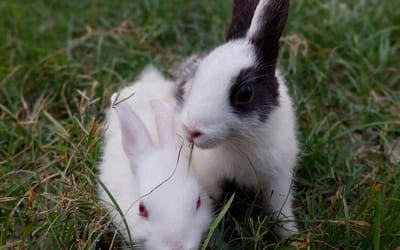
A medium rabbit of 2-2.5kg with one of the most recognisable markings in the fancy: a white wedge running up the face, a white front half and coloured rear, and white back feet. Compact, rounded and short-coated.
They are an old breed with none of the modern exaggerations - a normal skull, upright ears, a normal coat - and it shows in their health record, which is among the best of any rabbit.
Despite the name they are English, developed in the 1830s from the Petit Brabançon, a small Belgian rabbit exported through the Netherlands to the English meat trade. British fanciers selected for the markings and fixed the breed by the 1860s.
For most of the 20th century the Dutch was the most popular pet rabbit in Britain, until the lop and dwarf breeds displaced it.
2-2.5kg, compact and well-rounded with upright ears and a short glossy coat.
The markings are exacting: a white blaze up the face, a clean white collar and front, a coloured saddle beginning behind the shoulders, and white hind feet stopping at the hock. Black, blue, chocolate, steel, tortoiseshell and yellow.
Almost no litter produces show-perfect markings, which is why well-marked animals cost more and why there are plenty of affordable, perfectly healthy, imperfectly marked pet Dutch.
Even-tempered, confident and sociable. Dutch rabbits are usually calm to handle, curious about people and not prone to the flightiness of some smaller breeds.
They can be territorial about their own enclosure, particularly when unneutered, which neutering largely settles.
Bright and among the easier rabbits to litter-train. They learn names, routines and simple tricks, and they do well at rabbit agility. Clicker training works.
One of the better rabbit breeds for a family with older children: robust, calm and a sensible size - neither so small as to be fragile nor so large as to be unmanageable.
Keep in a neutered pair. Never with a guinea pig.
Notably few, and that is the breed's real advantage. A normal skull means far less dental disease than the dwarfs; upright ears mean far less ear disease than the lops; a short coat means no wool block.
What remains is what all rabbits get: gut stasis, an emergency within hours; myxomatosis and RHDV1/RHDV2, all usually fatal and all vaccine-preventable; flystrike from May to October; E. cuniculi; and dental disease if the diet is wrong.
Eight to twelve years is normal and some go beyond.
Hay topped up, water checked twice, litter tray cleaned, back end checked - twice daily in warm weather. Nails every six to eight weeks, vaccination annually.
A weekly brush, more during a moult. Nothing else. Never bathe.
3m x 2m x 1m as a permanent minimum, plus daily time in a larger space. Dutch are active and will use everything you give them - they are good runners and enthusiastic binkiers.
85% hay, unlimited. A daily handful of leafy greens, and a measured eggcup of single-component pellets. No muesli mixes.
£30-£80, with well-marked show-quality animals higher. Rescues rehome them at £50-£80 for a neutered vaccinated pair.
Setup £300-£600; running costs £600-£1,000 a year for a pair.
Check the front teeth and the ears, look at the back end, and see the mother handled.
Do not pay a premium for markings unless you intend to show. A Dutch with a crooked blaze is identical in every way that affects the animal's life, and there are a great many of them looking for homes.
Do not buy under eight weeks. Ask for the vaccination record and buy a bonded pair if you can.
No Dutches are advertised at the moment. Save this search and an email goes out when one is listed.
A shortlist rarely has one name on it. These sit closest to the Dutch on size, coat and temperament, and each one has a full guide.
Going to see a Dutch? Take the rabbit checklist with you. It is the questions worth asking while you are stood in somebody's kitchen, rather than on the drive home.