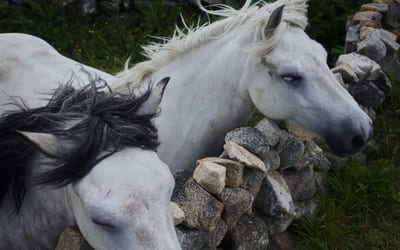
Connemara
Ireland's native pony and the best all-round performance pony in these islands: 13.2 to…
The Welsh Cob: over 13.2hh with no upper limit, powerful, high-actioned and famously bold. A genuine adult riding and driving horse with the hardiness of a native and the presence of something much more expensive.
We do not have enough Welsh Section D adverts yet to publish a price range from our own data. The figures in the price section below are an editorial estimate.
Scores are editorial, and describe the breed in general. Individual animals vary, and how a dog is bred and raised matters more than its breed.
Ask to see the certificates, with the parents' registered names on them. "Parents health tested" in an advert means nothing on its own.
The Welsh Cob: the largest of the four Welsh sections, exceeding 13.2 hands with no upper limit, though most stand 14.2 to 15.2. Powerful, deep-bodied and short-legged relative to their bulk, with a high knee action and a bold, workmanlike head.
They are among the most useful horses bred in Britain and the section that has kept the Welsh stud book commercially alive.
The Welsh Cob is old - referenced in medieval Welsh law - and was the militia horse, the farm horse and the trap horse of Wales for centuries. They were selected for the ability to trot fast under weight over rough ground, which is where the action comes from.
The Welsh Pony and Cob Society was founded in 1901 and the sections were formalised through the following decades.
137-160cm, 450-600kg. Deep through the girth, with powerful hindquarters, strong limbs, silky feather and an abundant mane and tail. The head is quality rather than heavy, with a bold eye.
Any solid colour; never piebald or skewbald.
Bold, honest and full of presence. Welsh Cobs are forward-going and courageous - they hunt all day, go first across country, and have a trot that turns heads.
They are also strong-minded. A Cob that has decided something takes real riding to talk out of it, and they are not a horse for a nervous rider.
Very trainable and very quick. They take to driving, jumping, dressage and hunting, and they hold their work well. They get bored with repetition and will invent variations.
They mature slowly and are often not fully developed until six or seven.
An adult's horse in most cases. Confident older teenagers manage them well, and many families keep a Cob as the one horse everybody can ride, but a novice child is not the right partner for one.
Live out well in company.
Laminitis, and it is the main one - a good doer of this size on good grazing is at real risk. Weight management is the daily job.
Equine Metabolic Syndrome and PPID, both blood-testable.
Mud fever and feather mites, every winter, from the feather.
Sweet itch. Sarcoids, common in the British population generally.
PSSM1, a muscle glycogen storage disorder found in cob and draught-type populations causing tying-up and reluctance to work. A simple DNA test exists and is worth doing on unknown breeding.
Daily checks, feet out daily, and winter checks under the feather. Farrier every six to eight weeks, teeth annually, vaccinations annually, worm counts through the season.
Weight-taped or condition-scored fortnightly.
Substantial mane, tail and feather, all traditionally left long for showing and all needing real attention through a wet winter. Thick winter coat that sheds heavily.
Clipping for a horse in hard winter work, with rugging to match.
Real work four to six days a week for a horse in regular use. They have stamina, they enjoy a job, and an under-worked Cob becomes both fat and opinionated.
Forage first and very little else unless in hard work. Soaked hay if weight is an issue, a balancer, and a hard look at the grazing.
£3,000-£8,000 for a well-schooled riding or driving horse, and £10,000-£30,000 for a proven show animal or a licensed stallion. Unbroken three-year-olds from £1,500.
Keeping one costs £3,000-£8,000 a year depending on livery.
Passport and microchip first. Ride it away from home, in traffic, and on a second visit.
Ask its age and have the vet age it from its teeth at the vetting - Cobs are frequently advertised younger than they are.
Get a five-stage vetting, ask about laminitis, and if the breeding is unknown add a PSSM1 test. It is about £40 and it explains a great many "lazy" cobs.
No Welsh Section Ds are advertised at the moment. Save this search and an email goes out when one is listed.
A shortlist rarely has one name on it. These sit closest to the Welsh Section D on size, coat and temperament, and each one has a full guide.
Going to see a Welsh Section D? Take the horse and pony checklist with you. It is the questions worth asking while you are stood in somebody's kitchen, rather than on the drive home.