Connemara
Ireland's native pony and the best all-round performance pony in these islands: 13.2 to…
The Pura Raza Espanola: a compact, powerful, elegantly built Iberian horse with a long history in classical riding. Exceptionally trainable and willing, and the most rideable of the showy breeds.
We do not have enough Andalusian adverts yet to publish a price range from our own data. The figures in the price section below are an editorial estimate.
Scores are editorial, and describe the breed in general. Individual animals vary, and how a dog is bred and raised matters more than its breed.
Ask to see the certificates, with the parents' registered names on them. "Parents health tested" in an advert means nothing on its own.
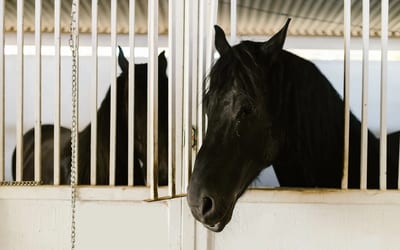
The Pura Raza Española - the Pure Spanish Horse - from Andalusia in southern Spain. 152-165cm, compact and powerfully built, with an arched neck, a convex or straight profile, and an abundant mane and tail.
"Andalusian" is the common English name; the studbook name is PRE and the registry is ANCCE. The related Portuguese breed is the Lusitano, and the two were one studbook until 1967.
Iberian horses are among the oldest identifiable types in Europe, depicted in cave art and prized by Rome. The Carthusian monks of Jerez maintained the studbook through the 15th to 19th centuries and their line is still regarded as the purest.
The breed was the war horse and the riding horse of the European courts, and it is the foundation of classical dressage - the movements taught at the Spanish Riding School were developed on these horses.
152-165cm, 450-600kg. Compact, deep-bodied and round, with strong sloping shoulders, powerful hindquarters and clean legs. A long, thick, often wavy mane and tail.
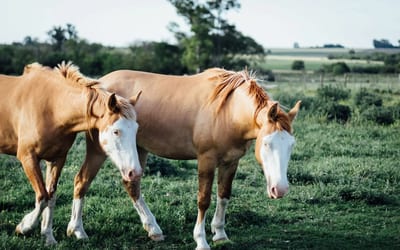
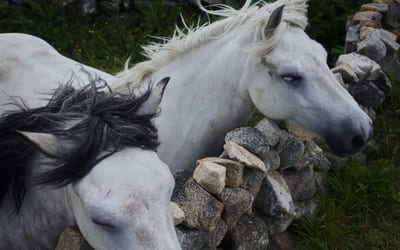
Grey predominates - around 80 per cent - with bay next. Most other colours are rare and some are not accepted for registration.
Kind, brave and willing, and unusual among showy breeds for being genuinely easy. They were bred to be ridden one-handed in war and in the bullring, which selected hard for courage and responsiveness without sharpness.
They bond strongly with their rider and are notably tolerant of a learner's mistakes.
Exceptional. They learn collected work readily because the conformation makes it natural - an uphill build, strong hocks and natural elevation. Riders coming from other breeds are often surprised how quickly piaffe and passage come.
They are willing to the point of trying too hard, and a tense rider produces a tense horse.
An adult's horse by size, and a good one for a confident, improving rider. The kindness is real and they are more forgiving than most horses of this ability.
Easy in a herd and sociable on the ground.
Sound overall, with few breed-specific inherited conditions, which is unusual among the showy breeds.
Laminitis. The main practical risk. They are efficient feeders on Iberian scrub and British grazing is far richer than anything they evolved for. Restricted turnout and weight management for most.
Equine Metabolic Syndrome, associated with the same efficiency.
Melanoma in greys, as in any grey horse, and with 80 per cent of the breed grey it is worth checking under the tail and around the sheath as they age. Usually slow-growing.
Hock arthritis with collected work over the years, which is a consequence of the job rather than a defect.
Twenty-two to thirty years, and many stay sound in work into their twenties.
Daily checks, feet out daily, farrier every five to seven weeks, teeth annually, vaccinations annually, worm counts through the season.
Weight monitoring is the recurring job.
The mane and tail are the work - long, thick and often wavy, and they tangle. Many owners plait or bag them between shows.
Coat is straightforward. Greys need more washing than they ought to.
Four to six days a week for a horse in work. They are built for collected, powerful work rather than speed or distance, and they are happiest doing something that asks for engagement rather than miles.
Forage first, and modestly. They hold weight easily and a fat Andalusian is at real laminitis risk. Soaked hay, a balancer, and conditioning feed only in hard work.
£6,000-£20,000 for a registered riding horse; £25,000-£80,000+ for a proven competition horse or a graded stallion. Unregistered "Spanish type" horses are cheaper and are a different thing.
Keeping one costs £4,000-£10,000 a year.
Ask for ANCCE or recognised studbook papers with DNA parentage verification and check the microchip. The PRE registry is strict and the papers are what separate a Pura Raza Española from a Spanish-type horse.
Ride it. The trainability is the reason to buy one and it is obvious within twenty minutes.
Five-stage vetting from your own vet, with hock radiographs for a competition prospect. Ask about laminitis history and look at the feet for growth rings.
No Andalusians are advertised at the moment. Save this search and an email goes out when one is listed.
A shortlist rarely has one name on it. These sit closest to the Andalusian on size, coat and temperament, and each one has a full guide.
Going to see a Andalusian? Take the horse and pony checklist with you. It is the questions worth asking while you are stood in somebody's kitchen, rather than on the drive home.