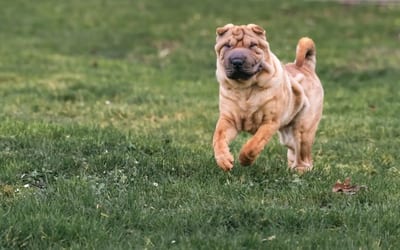
Shar Pei
A Chinese guarding breed with deep skin folds, a blue-black tongue and a hippopotamus…
An ancient Chinese breed with a lion-like ruff, a blue-black tongue and a famously aloof temperament. Independent to the point of being cat-like, heavy to groom, and prone to eyelid and joint problems.

We do not have enough Chow Chow adverts yet to publish a price range from our own data. The figures in the price section below are an editorial estimate.
Scores are editorial, and describe the breed in general. Individual animals vary, and how a dog is bred and raised matters more than its breed.
Ask to see the certificates, with the parents' registered names on them. "Parents health tested" in an advert means nothing on its own.
A sturdy, squarely built spitz of 20-32kg with an enormous standing ruff, a scowling expression, a stiff stilted gait and a blue-black tongue that no other breed but the Shar Pei shares.
They are among the oldest identifiable dog types, and they behave like a breed that has been independent for three thousand years - self-contained, dignified and unbothered about your approval.
Represented in Chinese art from the Han dynasty, two thousand years ago, and used as hunting dogs, guard dogs, cart dogs and, unsentimentally, for meat and fur. The name is thought to come from pidgin-English shipping terminology - "chow chow" being miscellaneous cargo.
They reached Britain in the late 18th century and became fashionable after Queen Victoria took an interest in the 1880s.
46-56cm, 20-32kg. Two coat types: rough, with the famous ruff, and smooth, which is dense and plush but short. Red, black, blue, cinnamon and cream.
The straight hind legs give the distinctive stilted walk, which is correct for the breed rather than a sign of lameness - though it does contribute to joint wear.
Aloof, dignified and often described as cat-like. A Chow picks its people and is indifferent to everybody else. They are not demonstrative, they do not follow you about, and they are not looking for constant interaction.
They are territorial and naturally suspicious of strangers. They are also, importantly, a breed with a low tolerance for being handled by people they have not chosen - which shapes who they suit.
Intelligent and thoroughly stubborn. A Chow understands what you want and decides separately whether to do it. Training works with patience, food and short sessions; it fails completely with force, which produces a dog that simply refuses.
Socialisation from the earliest possible age is essential and must continue for life, because the default setting is suspicion.
Not a natural children's dog. They dislike rough handling, they do not enjoy being grabbed or climbed on, and their tolerance is limited. A Chow raised with respectful older children can be fine; a household with toddlers is a poor match.
Same-sex dog aggression is common. Prey drive is moderate, and cats need raising together.
They also have very restricted peripheral vision because of the deep-set eyes and heavy ruff, so they startle when approached from the side - which is exactly how a child approaches a dog.
Entropion. Very common. The eyelid rolls inward and the lashes abrade the cornea, which is painful and causes ulceration. It needs surgical correction, often in the first year, and costs £1,000-£2,000. Look at the eyes of both parents and of the puppy: weeping, squinting or sore eyes are the sign.
Hip and elbow dysplasia, both common, partly from the straight hind angulation.
Hypothyroidism, patellar luxation, gastric torsion, and autoimmune conditions including pemphigus.
Heat intolerance. A dense double coat plus a moderately short muzzle means a Chow overheats faster than almost any other breed of its size. Summer exercise must be early morning or late evening, and a hot car is lethal.
Grooming, a modest walk in cool conditions, and a daily look at the eyes. Fresh water always, shade always, and in summer a cooling mat rather than a hot conservatory.
Substantial. A rough-coated Chow needs thorough brushing to the skin three or four times a week, and an hour at a time is not unusual. The ruff, the trousers and behind the ears mat hardest.
Two heavy sheds a year need daily work. Professional grooming every eight to twelve weeks is common and costs £50-£80.
Never shave them. The coat insulates both ways and often does not recover properly.
Low for the size - two half-hour walks suits most adults. They are not built for running and they overheat quickly. They will happily do less than you offer.
A moderate protein food, measured, twice daily. Chows are not usually greedy and many are fussy. Keep them lean; the joints are the weak point and a heavy Chow struggles.
£1,200-£2,500 from a breeder scoring hips and elbows and screening eyes.
Budget for entropion surgery as a realistic possibility, and for grooming at £300-£600 a year if you do not do it yourself. Insurance is £50-£100 a month.
Look hard at the eyes - of the puppy, of the mother, and of any other adults on the premises. Sore, weeping or half-closed eyes mean entropion in the line. Ask directly whether any dog they have bred has needed eyelid surgery.
Ask for hip and elbow scores and a thyroid result.
Watch how the mother reacts to you. Aloof and unbothered is correct. Fearful or snappy is not, and temperament here is substantially heritable.
Then be honest about the grooming. Several hours a week, every week, for twelve years - and the commonest reason Chows end up in rescue is a coat that got away from somebody.
No Chow Chows are advertised at the moment. Save this search and an email goes out when one is listed.
A shortlist rarely has one name on it. These sit closest to the Chow Chow on size, coat and temperament, and each one has a full guide.
Going to see a Chow Chow? Take the puppy and dog checklist with you. It is the questions worth asking while you are stood in somebody's kitchen, rather than on the drive home.