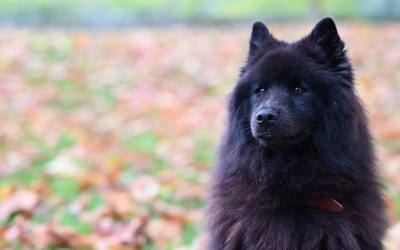
Chow Chow
An ancient Chinese breed with a lion-like ruff, a blue-black tongue and a famously aloof…
A large, dignified, profoundly loyal spitz from northern Japan. Reserved, strong-willed and frequently aggressive towards other dogs, which makes them a poor first dog and an outstanding one for the right owner.
We do not have enough Akita adverts yet to publish a price range from our own data. The figures in the price section below are an editorial estimate.
Scores are editorial, and describe the breed in general. Individual animals vary, and how a dog is bred and raised matters more than its breed.
Ask to see the certificates, with the parents' registered names on them. "Parents health tested" in an advert means nothing on its own.
A large spitz-type dog from the mountains of northern Japan, 32-59kg, with a dense double coat, a broad head, small triangular eyes and a curled tail. Two types exist: the Japanese Akita Inu, lighter and restricted to red, brindle and white, and the American Akita, heavier and permitted in all colours including the black mask that the Japanese type never has.
The Kennel Club recognises them as separate breeds here. They behave similarly.
Bred in Akita Prefecture for hunting bear, boar and deer, and later used for fighting and as guardians. The breed nearly vanished twice - during the Second World War when dogs were culled for their pelts, and through crossbreeding with German Shepherds to evade the cull.
Hachiko, who waited at Shibuya station every day for nine years after his owner died, is an Akita, and the story tells you the essential thing about the breed's attachment.
61-71cm, 32-59kg, males much heavier. A harsh standing outer coat over a thick soft undercoat. Powerful, substantial and slightly longer than tall.
Dignified, quiet and intensely loyal. An Akita bonds hard with its household and is typically aloof rather than hostile with strangers. They do not seek approval, which people raised on retrievers find disconcerting.
They rarely bark. When an Akita does make a noise, something is happening.
Dog aggression is the defining behavioural issue. Same-sex aggression especially is common, often appears at maturity regardless of socialisation, and in many dogs cannot be trained away - only managed. Many Akitas live best as the only dog in the household, and a prospective owner should plan for that rather than hope against it.
Very intelligent and entirely willing to ignore you. They were bred to hunt independently and to make their own decisions, and they will assess whether an instruction is worth following.
Training must start early, stay consistent and be reward-based. Force meets resistance in this breed, and an Akita that has decided you are unfair disengages completely. They bore quickly with repetition.
Recall is often never fully reliable, and many owners simply accept a long line for life.
Good with the children of their own family and generally tolerant, but they are large, strong and not naturally forgiving of rough handling, and their reaction to a strange child is unpredictable. Supervision is not optional.
Other dogs: see above. Small animals: high prey drive, and cats are usually a bad idea unless raised together from puppyhood, and sometimes even then.
Autoimmune disease. Akitas are over-represented for several - sebaceous adenitis, which destroys the skin's oil glands and causes scaling and hair loss, Vogt-Koyanagi-Harada-like syndrome, which attacks the eyes and depigments the nose and coat, and pemphigus. Ask about autoimmune history in the line specifically.
Hip and elbow dysplasia. Hypothyroidism, common. Progressive retinal atrophy. Gastric dilatation-volvulus, deep chest.
Akitas also have unusual drug sensitivities - they react badly to some anaesthetics and to certain sedatives, and their blood cell characteristics differ from other breeds enough to confuse routine tests. Tell any vet you see that the dog is an Akita.
An hour or more of exercise, a brush, and a check of the skin - scaling along the back or a musty smell is sebaceous adenitis and it needs seeing early.
Management is a daily habit with this breed: doors, gates, leads, and knowing where other dogs are before you let yours out of the car.
Weekly brushing most of the year, then two catastrophic sheds a year where the entire undercoat comes out over two or three weeks and needs daily work with a rake and a deshedding tool. The quantity genuinely surprises first-time owners.
Never shave an Akita. The double coat insulates against heat as well as cold.
Moderate: an hour to ninety minutes daily, on lead in most places. They are not endurance athletes and they are not built for hot weather at all.
Mental work is better received than repetition. Scent games and puzzle feeders suit the independent-thinking temperament.
Two measured meals with rest either side. Akitas do well on moderate protein and can be sensitive digestively; several do better on fish-based food. Keep lean for the joints.
£1,200-£2,500 from a health-tested breeder.
Insurance is £60-£120 a month, and worth checking carefully: some insurers load or exclude Akitas, and third-party liability cover matters for a dog with this profile.
Ask about temperament in the line, and about dog aggression specifically, and judge the honesty of the answer. A breeder who tells you Akitas are fine with all dogs if socialised properly is either inexperienced or selling.
Ask for hip and elbow scores, thyroid results and eye certificates, and ask directly whether any dog in the line has had an autoimmune condition.
Meet the mother. You are looking for calm and aloof, not fearful and not sharp.
Then think about your circumstances honestly: an Akita is a fifteen-year commitment to managing a dog that may never be able to meet another dog, and that is a real constraint on walks, holidays and the rest of your life.
No Akitas are advertised at the moment. Save this search and an email goes out when one is listed.
A shortlist rarely has one name on it. These sit closest to the Akita on size, coat and temperament, and each one has a full guide.
Going to see a Akita? Take the puppy and dog checklist with you. It is the questions worth asking while you are stood in somebody's kitchen, rather than on the drive home.