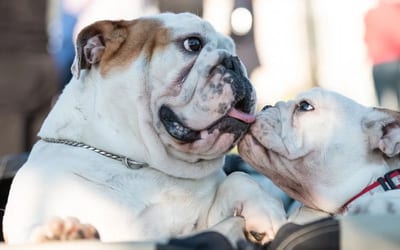
English Bulldog
Placid, funny and famously good with children, and the breed with the most serious…
A Chinese guarding breed with deep skin folds, a blue-black tongue and a hippopotamus muzzle. Calm and devoted at home, and carrying an inherited inflammatory disease that most of the breed has some version of.

We do not have enough Shar Pei adverts yet to publish a price range from our own data. The figures in the price section below are an editorial estimate.
Scores are editorial, and describe the breed in general. Individual animals vary, and how a dog is bred and raised matters more than its breed.
Ask to see the certificates, with the parents' registered names on them. "Parents health tested" in an advert means nothing on its own.
A medium Chinese guarding dog of 18-29kg, instantly recognisable for its loose wrinkled skin, small sunken eyes, blue-black tongue and broad padded muzzle. The name means "sand skin", after the harsh, prickly coat.
They are a breed where the features that make them distinctive are the same features that make them ill, and a buyer should go in understanding that.
An ancient southern Chinese breed used for herding, hunting and guarding, and later for fighting - the loose skin let a dog turn inside its own hide when gripped. The breed nearly vanished under the People's Republic and by 1970 was recorded as the rarest dog in the world.
It was rebuilt in Hong Kong and America from a very small number of dogs, and that bottleneck is the direct cause of its health profile. The heavily wrinkled "meatmouth" type popular today is a Western exaggeration of the original, flatter-coated "bonemouth" dog.
46-51cm, 18-29kg. Square, compact and substantial. Three coat types: horse (very short and harsh), brush (up to 2.5cm) and bear (longer, not permitted in the show ring). All are prickly to the hand.
Wrinkling should be pronounced on the head and shoulders. Puppies are far more wrinkled than adults and much of it grows out.
Calm, independent and reserved. A Shar Pei is devoted to its own household and indifferent to strangers, and it is naturally suspicious rather than outgoing. They are quiet dogs, often described as dignified, and they are clean - many house-train themselves quickly.
They can be stubborn, and they are not a breed looking for your approval.
Intelligent and self-willed. They learn fast and comply selectively. Early socialisation is essential and needs to continue, because the default is wariness, and a poorly socialised Shar Pei becomes reactive.
Their restricted vision, from the deep-set eyes and heavy brow, makes them startle when approached from the side - which matters for training and for children.
Tolerant of the children in their own family, and generally not a natural children's dog. They dislike rough handling and their reserve extends to visiting children.
Same-sex dog aggression is common; the fighting history is not entirely historical. Prey drive is moderate.
This is the section that should decide the purchase.
Shar Pei autoinflammatory disease (SPAID), formerly Familial Shar Pei Fever. Episodes of high fever with swollen, painful hocks, lasting a day or two. It is caused by an overproduction of hyaluronic acid - the same thing that produces the wrinkles - so it is intrinsic to the breed's defining feature. There is a DNA test for the risk haplotype and both parents should have been tested.
Repeated episodes lead to renal amyloidosis, protein deposits in the kidneys, which is the commonest cause of early death in the breed. Many Shar Pei die of kidney failure before eight.
Entropion. Very common and often needs surgery in the first six months - the folds roll the eyelid inward onto the cornea. Untreated it causes ulceration and blindness.
Skin fold dermatitis, infection in the damp warm folds. Otitis, because the ear canals are unusually narrow. Hypothyroidism. Hip and elbow dysplasia. Cutaneous mucinosis.
Folds cleaned and, crucially, dried every day - a damp fold is where infection starts. Ears checked. Eyes checked. Temperature worth knowing how to take, because a fever episode needs prompt veterinary attention.
Know what your dog's normal water intake is, so that an increase - the early sign of kidney trouble
Coat itself is simple: a weekly rub. The folds are the work. Wipe with a damp cloth and dry thoroughly, every day, particularly the face, the muzzle and the tail base.
Bathing monthly with a veterinary shampoo if the skin is prone. Dry completely afterwards.
Low: two half-hour walks. They overheat badly - a short muzzle, dense coat and heavy skin - so summer exercise is early or late, never in the middle of the day, and never hard.
A good quality food, often a limited-ingredient one, as food sensitivity is common. Two measured meals. If kidney disease develops, diet becomes the main treatment, so a vet who knows the breed is worth finding early.
£1,200-£2,500.
The lifetime cost is where this breed differs from most. Entropion surgery £1,000-£2,000. Skin and ear treatment recurring. Kidney monitoring and management from middle age. Insurance runs £70-£140 a month and several insurers exclude skin and eye conditions for this breed, so read the policy in detail before buying the dog.
Ask for the SPAID DNA result on both parents and do not accept "they have never had a fever" as an answer - the test exists and it is inexpensive.
Ask about kidney disease and age at death in the line, directly.
Look at the eyes of the puppy and both parents. Weeping, squinting or half-closed eyes mean entropion.
And prefer a moderately wrinkled dog to a heavily wrinkled one. The wrinkles are what sells the puppy and they are also, quite literally, the mechanism of the disease.
No Shar Peis are advertised at the moment. Save this search and an email goes out when one is listed.
A shortlist rarely has one name on it. These sit closest to the Shar Pei on size, coat and temperament, and each one has a full guide.
Going to see a Shar Pei? Take the puppy and dog checklist with you. It is the questions worth asking while you are stood in somebody's kitchen, rather than on the drive home.