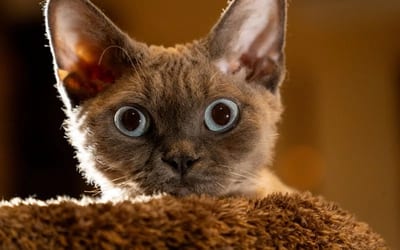
Devon Rex
A small, wavy-coated, enormous-eared cat with the personality of a monkey. Mischievous,…
A solid black shorthair with copper eyes and a patent-leather coat, bred to look like a miniature panther and built on Burmese foundations. Sociable, vocal and demanding of company.

We do not have enough Bombay adverts yet to publish a price range from our own data. The figures in the price section below are an editorial estimate.
Scores are editorial, and describe the breed in general. Individual animals vary, and how a dog is bred and raised matters more than its breed.
Ask to see the certificates, with the parents' registered names on them. "Parents health tested" in an advert means nothing on its own.
A medium shorthaired cat of 3-5.5kg, entirely black - coat, nose leather and paw pads - with large round copper or gold eyes. The coat is very short and close, and lies so flat that it looks lacquered.
Two versions exist. The American Bombay comes from Burmese crossed with black American Shorthair; the British Bombay from Burmese crossed with black domestic shorthairs, and is recognised by the GCCF as a Burmese variant. Both behave like Burmese.
Nikki Horner of Louisville, Kentucky, set out in 1958 to breed a cat that looked like a miniature Indian black panther, crossing a sable Burmese with a black American Shorthair. It took her until 1965 to get what she wanted, and CFA recognised the breed in 1976.
The name is for Bombay, as the port of the Indian leopard, and has nothing to do with the breed's origins.
23-28cm, 3-5.5kg. Medium, muscular and surprisingly heavy for the size, in the Burmese way. A rounded head, medium ears set wide, and a short muzzle with a slight nose break.
The coat must be black to the roots. Kittens are often born with faint ghost tabby markings and a slightly rusty cast that clears by about two years. Eye colour deepens over the same period.
Extrovert, affectionate and firmly attached. Bombays follow their people around, sit on whatever is being used, greet visitors and expect to be part of things. They are warmth-seekers and will get under a duvet.
They are vocal in the Burmese manner - a soft, insistent, conversational voice, used often.
They do not cope well alone. A Bombay left all day every day becomes unhappy, and two cats is often the kinder arrangement.
Bright and busy. Many fetch, several take to a harness, and most learn to open doors they should not. Puzzle feeders and training sessions are worthwhile rather than optional.
Very good with children - robust, sociable and tolerant, and actively interested in whatever is going on. Good with dogs, which many simply adopt as company.
Fine with other cats, and a second cat is worth considering given how poorly they take solitude.
Bombays carry the Burmese inheritance, which is the thing to screen for.
Burmese head defect, a lethal craniofacial deformity carried in contemporary Burmese lines. DNA testable, and both parents should be clear or the mating planned so no affected kitten results.
Hypokalaemia, episodic muscle weakness from low blood potassium, DNA testable.
Hypertrophic cardiomyopathy, screened by echocardiogram.
Excessive tearing, from the shortened muzzle and the tear duct anatomy. Common, mostly cosmetic, and needs daily wiping in some cats.
Gingivitis, as in Burmese generally. Diabetes risk is somewhat elevated through the Burmese line, so weight matters.
Some breeding lines have been selected for a very short muzzle, and those cats can snuffle and have more eye discharge. A moderate face is the healthier choice.
Company, play, measured food, and a wipe of the eyes if the cat tears. Weigh monthly given the diabetes risk in the background.
Almost nothing. A rubber mitt or a chamois once a week brings the shine up and removes the little they shed. No undercoat means no matting.
Teeth brushed if tolerated, because gingivitis runs in the line.
Moderate to high for a cat and largely your responsibility. Twice-daily wand play, a tall climbing frame and puzzle feeders. A bored Bombay finds occupation in your belongings.
Measured, wet-led meals, twice or three times daily. They are enthusiastic about food and the Burmese background makes weight a genuine health matter rather than a cosmetic one.
£500-£1,200 from a GCCF-registered breeder with the Burmese DNA panel done.
Running costs low. Insurance moderate.
Ask for the head defect and hypokalaemia DNA results on both parents - these are the specific Burmese tests and a serious breeder will have them. Ask for the date of the cardiac scans.
Check the coat to the roots and look at the face: a moderate muzzle with clear eyes is what you want, not an extreme short face with constant weeping.
A black domestic shorthair is a lovely cat and is not a Bombay. Ask for registration papers, and if what you actually want is a friendly black cat, your local rescue has several and they need homes.
No Bombays are advertised at the moment. Save this search and an email goes out when one is listed.
A shortlist rarely has one name on it. These sit closest to the Bombay on size, coat and temperament, and each one has a full guide.
Going to see a Bombay? Take the kitten and cat checklist with you. It is the questions worth asking while you are stood in somebody's kitchen, rather than on the drive home.