Bombay
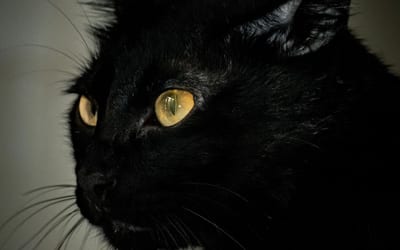
A solid black shorthair with copper eyes and a patent-leather coat, bred to look like a…
A fine-boned cat with no guard hairs, only a soft marcel-waved undercoat. Warm to the touch, astonishingly active, and permanently in search of the warmest spot in the house.
We do not have enough Cornish Rex adverts yet to publish a price range from our own data. The figures in the price section below are an editorial estimate.
Scores are editorial, and describe the breed in general. Individual animals vary, and how a dog is bred and raised matters more than its breed.
Ask to see the certificates, with the parents' registered names on them. "Parents health tested" in an advert means nothing on its own.
A small, fine-boned cat of 2.5-4.5kg whose coat has no guard hairs at all - only the soft downy undercoat, arranged in tight marcel waves. It feels like crushed velvet and is warm to the hand, because there is very little between you and the cat.
Arched back, long legs, a whippet-like outline, large ears set high, and an oval head with prominent cheekbones.
One kitten, Kallibunker, born on a farm at Bodmin Moor in Cornwall in 1950 to an ordinary tortie queen. His owner Nina Ennismore, who had bred rex rabbits, recognised what she was looking at and bred him back to his mother.
The gene is recessive and the founding population was tiny, which is why outcrossing to Siamese, Burmese and British Shorthair was used to widen it. The Devon Rex, found ten years later in the next county, is a different gene entirely - crossing the two produces straight-coated cats.
20-25cm, 2.5-4.5kg. Slender and muscular with a deep chest and a fine skeleton - they weigh less than they look. The whiskers are short, curled and brittle, and often break.
Any colour or pattern. The coat lies in even waves from head to tail.
Extrovert, busy and demanding of attention. Cornish Rex are kitten-like for life: they climb, leap, fetch, and involve themselves in whatever is happening. Many ride on shoulders.
They are vocal, warm-seeking and relentlessly sociable. If you want a cat that sits quietly across the room, this is not it.
Very bright. They fetch, learn names, open things and take readily to harness training. They need mental work, and a Cornish Rex with nothing to do becomes a nuisance rather than a sulk.
Good with both. They are robust in spirit if not in frame, and they enjoy the traffic of a family household. Small children need showing that this is a light-boned cat.
Sociable with other cats and dogs, and they usually seek out the warmest animal in the house to sleep against.
Hypertrophic cardiomyopathy, screened by echocardiogram. Ask for dates rather than a single kitten scan.
Congenital hypotrichosis, where kittens are born bald and stay so, occurs in some lines.
Patellar luxation, seen more in the fine-boned rex breeds.
Umbilical hernia occurs with some frequency and is usually minor.
Cold intolerance. Not a disease but a genuine welfare matter: with no guard hairs and little body fat, a Cornish Rex loses heat fast. They need a warm house, soft warm places to sleep, and should not be let out in a British winter for long.
Their higher body temperature and fast metabolism mean they eat more than their size suggests.
Play, warmth, food, and company. Check the ears - rex breeds produce more wax than most and it builds up.
Provide heated beds or a radiator hammock. Watch that they do not sleep against something hot enough to burn; they will if allowed.
Almost no brushing - a rough brush damages the delicate coat. A hand-stroke or a soft cloth is enough.
What some need instead is bathing. With no guard hairs to wick oil away, the skin can get greasy, particularly in males, and a wash every few weeks with a gentle shampoo keeps it in order. Introduce it as a kitten and it is straightforward.
Ears cleaned weekly. Nails trimmed monthly.
High, and largely self-generated. They need height, space to sprint and an owner willing to play twice a day. Cat trees, shelves and puzzle feeders all earn their keep.
Indoor life suits them, for warmth and because they are trusting and conspicuous.
More than you would expect for the size. High metabolism and heat loss mean a Cornish Rex burns through calories. Good quality food, two or three meals, and free access to a measured daily ration works better than strict portioning for most.
£500-£1,200 from a GCCF-registered breeder with HCM screening.
Running costs modest, apart from heating - which is a real and slightly comic consideration with this breed.
Ask for the date of the parents' echocardiograms and the PKD result.
Handle the kitten. The coat should feel like warm velvet with even waves and no bald patches; a patchy or sparse coat in a young kitten can be hypotrichosis rather than a coat still coming in.
Ask whether the line has had patella problems.
And think about your house. A cold flat with no heating during the day is genuinely unsuitable for this breed, in a way that is not true of most cats.
No Cornish Rexes are advertised at the moment. Save this search and an email goes out when one is listed.
A shortlist rarely has one name on it. These sit closest to the Cornish Rex on size, coat and temperament, and each one has a full guide.
Going to see a Cornish Rex? Take the kitten and cat checklist with you. It is the questions worth asking while you are stood in somebody's kitchen, rather than on the drive home.