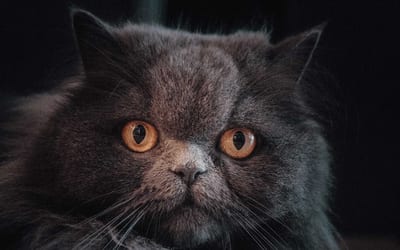
British Longhair
A British Shorthair in a long coat: the same round, placid, undemanding cat with more…
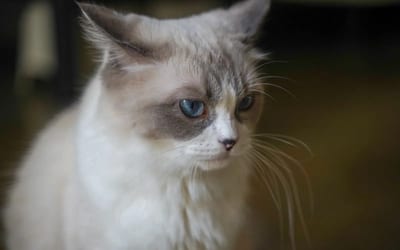
A colourpointed semi-longhair with sapphire eyes and four white feet, bred for calm. Gentler and quieter than a Siamese, easier to groom than a Persian, and one of the most even-tempered cats available.

We do not have enough Birman adverts yet to publish a price range from our own data. The figures in the price section below are an editorial estimate.
Scores are editorial, and describe the breed in general. Individual animals vary, and how a dog is bred and raised matters more than its breed.
Ask to see the certificates, with the parents' registered names on them. "Parents health tested" in an advert means nothing on its own.
A medium-large semi-longhaired cat, 4-7kg, with a pale body, darker points on the face, ears, legs and tail, deep blue eyes, and - the breed's signature - four white feet. The front white "gloves" should stop at the wrist; the back "laces" run up the back of the hock.
They are often confused with the Ragdoll and the Himalayan. The white feet are the quick tell, and the coat is silkier and lighter than either.
The romantic version has temple cats in Burma taking on the golden coat and blue eyes of the goddess Tsun-Kyan-Kse, with white feet where a priest's hands rested. The documented version is that the breed appears in France in the 1920s, probably from imported Burmese temple stock crossed with Siamese and Persian.
The European population was reduced to two cats by the end of the Second World War and rebuilt by outcrossing. The GCCF recognised the breed in 1966.
25-30cm, 4-7kg, males larger. Medium-long silky coat with no woolly undercoat, which is why it mats far less than a Persian's. A full ruff around the neck and a bushy tail.
Seal, blue, chocolate, lilac, red, cream and tortie points, plus tabby points. Kittens are born pure white and develop their points over weeks; the full adult colour takes up to two years.
The breed was selected for temperament and it shows. Birmans are calm, gentle and quietly affectionate - they follow their people around, sit beside rather than on, and greet visitors without fuss.
They are far less vocal than a Siamese, with a soft chirrup rather than a yowl. They are curious but not destructive, playful but not frantic. This is about as easy as a pedigree cat gets.
Bright, moderately playful, and biddable. Many learn their name and simple tricks, and they take to harness walking more readily than most. They are not the problem-solvers a Burmese or a Bengal is, which most owners count as a mercy.
One of the best breeds for a family. They tolerate handling, are slow to scratch, and enjoy company. They are large enough not to be fragile.
Reliably good with other cats and usually untroubled by dogs. A Birman is often the cat that settles a multi-pet household rather than disrupting it.
Hypertrophic cardiomyopathy. The main concern. Both parents should have had an echocardiogram by a cardiologist, repeated periodically rather than once as a kitten, and you should ask for the dates.
Polycystic kidney disease, DNA testable, present in the breed through its Persian ancestry.
Congenital hypotrichosis, a rare inherited condition where kittens are born with little hair and have compromised immune systems. DNA testable.
Neonatal isoerythrolysis. Birmans have an unusually high frequency of blood type B, and a type B queen mated to a type A tom produces kittens that can be killed by their own mother's first milk. Breeders manage this by blood typing, and a breeder who has not typed their cats is one to question.
Otherwise a fairly robust breed, with thirteen to sixteen years typical.
Feed, litter, a brush, and some attention - they want to be with you, and a Birman that is ignored gets quietly sad rather than badly behaved. Check the white feet, which pick up litter and dirt.
Easier than the coat length suggests. No undercoat means far less matting than a Persian, but the ruff and the "trousers" behind the back legs still need attention.
Comb two or three times a week, more during the spring moult, paying attention to behind the ears, the armpits and the britches. A full mat needs cutting out and is uncomfortable, so the habit matters more than the tool.
The white feet stain. A damp cloth and, if you show, a little cornflour.
Moderate and undemanding. A cat tree, wand toys and a window with something to look at covers most of it. They are not great jumpers or climbers by cat standards and are content at lower levels.
Many are kept indoors, which suits them - they are trusting and not street-wise.
A good quality complete food, measured, in two meals. They are not usually greedy, but neutered adults in a warm house gain weight quietly under a long coat, so use your hands rather than your eyes to judge condition.
£600-£1,400 from a GCCF-registered breeder with HCM and PKD screening.
Running costs are unexceptional. Insurance is moderate, and worth having for the cardiac risk.
Ask for the date of the parents' echocardiograms, not just whether they have been done - HCM develops with age, so a scan from five years ago on a seven-year-old cat tells you little. Ask for the PKD result and the blood types of both parents.
Look at the feet. Symmetrical white gloves stopping cleanly at the wrist are the breed standard, and uneven or creeping white is a fault rather than a health problem, but it tells you something about how carefully the litter was planned.
Do not be alarmed that the kitten is white. They all are. Ask what colour the parents are and you will know roughly what you are getting.
No Birmans are advertised at the moment. Save this search and an email goes out when one is listed.
A shortlist rarely has one name on it. These sit closest to the Birman on size, coat and temperament, and each one has a full guide.
Going to see a Birman? Take the kitten and cat checklist with you. It is the questions worth asking while you are stood in somebody's kitchen, rather than on the drive home.