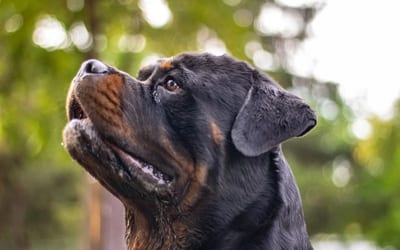
Rottweiler
Powerful, confident and deeply loyal, and one of the most misunderstood breeds in Britain.…
An elegant, fast, highly intelligent guarding breed that bonds intensely with one household. Its health record is dominated by one statistic: well over half of Dobermanns develop dilated cardiomyopathy, and most die of it.

We do not have enough Dobermann adverts yet to publish a price range from our own data. The figures in the price section below are an editorial estimate.
Scores are editorial, and describe the breed in general. Individual animals vary, and how a dog is bred and raised matters more than its breed.
Ask to see the certificates, with the parents' registered names on them. "Parents health tested" in an advert means nothing on its own.
A large, square, short-coated guarding dog of 32-45kg, built for speed and endurance rather than bulk. Bred deliberately as a protection dog in the 1890s and refined since into one of the most biddable working breeds in existence.
The British spelling keeps the second n, after Karl Friedrich Louis Dobermann who created them. The American registries dropped it and added "Pinscher".
Dobermann was a tax collector and night watchman in Apolda, Thuringia, who also ran the local dog pound - an unusual combination that gave him both a reason to want a protection dog and the material to make one. He worked in the 1880s from German Pinscher, Rottweiler, Weimaraner and black-and-tan terrier stock.
The breed was fixed within about twenty years, which is exceptionally fast, and that speed is part of why the genetic base is narrow enough to carry the health problems it does. Used heavily as military and police dogs through both wars.
63-72cm, 32-45kg. Square in outline, deep-chested, with a compact tight-lipped head. Short, hard, close-lying coat in black, brown, blue or fawn, all with rust markings.
Cropped ears and docked tails are illegal in the UK. A Dobermann with cropped ears has been imported or done abroad, and it is worth asking hard questions about where a dog like that came from.
Alert, intense and deeply attached. A Dobermann typically bonds to a whole household and shadows one person within it - the breed is sometimes called a velcro dog, and it is accurate.
Properly bred and socialised they are confident rather than nervy, and stable enough to live easily with children. The reputation for unpredictability belongs to a period of poor breeding decades ago and to dogs kept badly. A fearful or sharp Dobermann is a badly bred one.
Near the top of any ranking, and they need the work. A Dobermann learns a new behaviour in a handful of repetitions and will then test whether the rule still applies. They excel at obedience, tracking, agility and IGP.
They are sensitive dogs. Harsh handling does not produce a hard dog, it produces a shut-down or a defensive one. Reward-based training with clear consistent boundaries is what this breed is built for.
Good with children in their own family, and their size and speed mean supervision with small ones is about physics rather than temperament. They are protective, which needs managing when a child's friends come round and the play gets loud.
Same-sex dog aggression occurs. Early, ongoing socialisation matters more in this breed than most.
Dilated cardiomyopathy. The defining issue and it cannot be overstated. Studies put lifetime incidence at roughly 58 per cent, and in many dogs the first sign is collapse or sudden death. The heart muscle thins and the chambers dilate; by the time there are symptoms the disease is usually advanced.
There are two DNA markers, DCM1 and DCM2, but neither is a clean predictor - dogs clear of both still develop it. The real screening is an annual echocardiogram plus Holter monitor from about three years old. Ask a breeder for the parents' most recent results with dates. A breeder who health-tests hips and eyes but not hearts is not testing for the thing that will kill the dog.
Medication started at the pre-clinical stage genuinely extends life, which is the reason annual screening is worth the money.
Von Willebrand disease type 1, a bleeding disorder, very common in the breed and DNA testable - there is no excuse for an untested litter.
Cervical spondylomyelopathy (wobbler syndrome), a compression of the spinal cord in the neck causing an unsteady gait. Hypothyroidism, common and easily treated. Bloat, being deep chested. Chronic active hepatitis. And congenital deafness associated with the white or albino colour, which should not be bred at all.
Substantial exercise, training, and company. Learn what normal breathing and normal exercise tolerance look like for your dog so you notice when it changes - coughing, reluctance to walk, a swollen abdomen or fainting are all cardiac signs needing a same-day vet.
A coat in winter. The short coat and low body fat mean a Dobermann genuinely feels the cold.
Minimal. A rubber mitt weekly; they shed steadily but lightly. Nails, teeth, and ears checked. Check the skin while grooming - the breed gets colour dilution alopecia in blues and fawns.
High. Two hours a day for an adult, with real running and some mental work. They are built to trot for miles and sprint when needed.
Keep a puppy's exercise controlled until the growth plates close at fifteen to eighteen months - no long runs, no repetitive jumping, no stairs where avoidable.
Two measured meals with rest either side, for bloat. A good quality food suited to a large active dog. Keep them lean - the visible ribs that look thin on a Labrador are correct on a Dobermann, and extra weight loads a heart that may already be failing.
Taurine and carnitine deficiency is associated with DCM in some dogs, so discuss diet with your vet rather than following an internet consensus.
£1,200-£2,500 from a breeder doing annual cardiac screening and DNA tests. Below £900 you are almost certainly buying from a litter with no cardiology behind it.
Insurance is expensive and worth every penny: £70-£140 a month on an adult. Cardiac work-ups, Holter monitors and lifelong medication add up quickly.
There is one question that matters more than all the others: when were both parents last echocardiogrammed and Holtered, and what were the results? Ask for the reports. A serious Dobermann breeder will send them without hesitation because they are proud of them.
Then ask for the von Willebrand DNA result, the hip score, and how old the grandparents were when they died and of what. That last question tells you more about a Dobermann line than any single test.
Do not buy a white Dobermann. They are albino, they come with eye and skin problems, and the breeding of them is opposed by every serious club.
No Dobermanns are advertised at the moment. Save this search and an email goes out when one is listed.
A shortlist rarely has one name on it. These sit closest to the Dobermann on size, coat and temperament, and each one has a full guide.
Going to see a Dobermann? Take the puppy and dog checklist with you. It is the questions worth asking while you are stood in somebody's kitchen, rather than on the drive home.