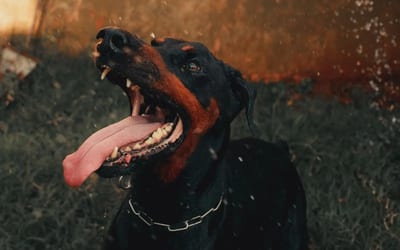
Dobermann
An elegant, fast, highly intelligent guarding breed that bonds intensely with one…
A powerful, athletic working dog that behaves like a puppy until about three and stays playful long after. Superb with children, and carrying two serious inherited heart conditions plus one of the highest cancer rates of any breed.
We do not have enough Boxer adverts yet to publish a price range from our own data. The figures in the price section below are an editorial estimate.
Scores are editorial, and describe the breed in general. Individual animals vary, and how a dog is bred and raised matters more than its breed.
Ask to see the certificates, with the parents' registered names on them. "Parents health tested" in an advert means nothing on its own.
A medium-large working dog of 25-32kg, square in outline, deep-chested, with a short broad muzzle and an undershot jaw. Bred as a hunting and holding dog and later as one of the first police breeds, they have a working dog's drive attached to an unusually silly temperament.
They are one of the best family dogs in Britain and one of the shorter-lived, and both of those facts should be in front of you before you buy.
Developed in Germany in the 1890s from the Bullenbeisser, a now-extinct hunting dog that gripped boar and deer until the hunter arrived, crossed with English Bulldog. The undershot jaw and broad muzzle are direct inheritances from that work - a dog holding a boar needs to breathe while its mouth is full. The Munich breed club standardised them in 1896, and they were among the first breeds taken for police and military work.
53-63cm, 25-32kg, with males noticeably heavier. Short, tight, glossy coat in fawn or brindle, usually with white markings. The head should be in proportion, with a muzzle a third the length of the head - the very short extreme faces seen in some lines breathe worse and are not correct.
Docked tails and cropped ears are illegal in the UK and you should not see either on a British-bred dog. A cropped-ear Boxer in an advert has almost certainly been imported, and often badly.
Exuberant, affectionate and profoundly silly. Boxers mature slowly, physically and mentally - a three-year-old still behaves like an adolescent. They are people dogs to an unusual degree and do poorly left alone for long stretches.
They are alert and will announce a visitor, and a Boxer standing its ground is intimidating, but genuine aggression is out of character and a red flag in a line.
Intelligent, quick, and easily bored by repetition. They learn fast and then get creative, which handlers read as stubbornness. Short, varied, upbeat sessions work; drilling does not.
Start early and be consistent about jumping up, because a habit that is funny in a puppy is a problem in a 30kg adult that greets a visitor at chest height.
One of the great children's dogs, with real patience and a high tolerance for being climbed on. The caveat is size and momentum rather than temperament - a young Boxer at full tilt will knock a toddler flat without meaning anything by it.
Generally good with dogs they are raised with. Same-sex adult aggression occurs in some lines, and a strong prey drive means cats need a careful introduction.
This is the section that decides whether a Boxer is the right dog for you.
Boxer cardiomyopathy (ARVC). An inherited electrical disease of the heart muscle that causes arrhythmias, collapse and sometimes sudden death in a dog with no prior symptoms. Screened with a 24-hour Holter monitor, not a stethoscope. Both parents should have been Holtered within the year before mating, and you should ask to see the results.
Aortic stenosis, a narrowing below the aortic valve, found by cardiac auscultation and confirmed by echocardiogram.
Cancer. Boxers have among the highest rates of any breed - mast cell tumours, lymphoma and brain tumours particularly. Learn to check for lumps, and take new ones to a vet rather than watching them.
Degenerative myelopathy, a progressive spinal cord disease of older dogs, with a DNA test. Hip dysplasia, hypothyroidism, and bloat, being a deep-chested breed.
And they are moderately brachycephalic. A Boxer in hot weather overheats quickly and cannot cool itself well.
Real exercise twice a day, a wipe of the face folds, and a hands-on check for lumps while you are stroking them - which with a Boxer is most of the evening. Insurance in place from day one.
Almost nothing. A rubber mitt once a week removes the loose hair, and they shed steadily rather than seasonally. Wrinkles on the muzzle wiped and dried. Nails kept short; Boxers are hard on their feet.
White-marked dogs sunburn on the nose and ear tips in summer.
High. An adult wants an hour and a half to two hours a day, in more than one session, with room to run. They are built to sprint and turn, and a Boxer that only gets lead walks becomes destructive.
Growth plates close late in this breed, so keep a puppy off long runs, stairs and repetitive jumping until fifteen to eighteen months.
Avoid the middle of the day in summer entirely.
Two measured meals rather than one, with rest either side - deep chests and bloat. Boxers can be sensitive digestively and several do better on a limited-ingredient food. Keep them lean; the extra weight goes onto a heart that may already be compromised.
£1,200-£2,200 from a breeder Holter-testing and cardiac screening. Below about £900 you are usually looking at a litter with no cardiology behind it, which in this breed is the test that matters most.
Budget realistically for insurance - £60-£120 a month on an adult, and rising steeply with age, because insurers know the cancer figures.
Ask three questions and take the answers seriously. Have both parents been Holter monitored, when, and what were the results? Has either parent had an echocardiogram for aortic stenosis? How old were the grandparents when they died, and of what?
A good Boxer breeder will have all of this and will want to talk about it. One who says the dogs have "been checked by the vet" is describing a stethoscope, which does not detect ARVC.
Do not buy a Boxer with cropped ears or a docked tail. And look hard at the muzzle - if the dog is snuffling at rest in a cool room, the face is too short.
No Boxers are advertised at the moment. Save this search and an email goes out when one is listed.
A shortlist rarely has one name on it. These sit closest to the Boxer on size, coat and temperament, and each one has a full guide.
Going to see a Boxer? Take the puppy and dog checklist with you. It is the questions worth asking while you are stood in somebody's kitchen, rather than on the drive home.