Warmblood
Not a breed but a group of European studbooks - Hanoverian, Holsteiner, Dutch, Oldenburg…
The largest and most successful warmblood studbook, from Lower Saxony. Bred by rigorous inspection and performance testing for dressage and showjumping, and the standard against which other sport horse programmes are measured.
We do not have enough Hanoverian adverts yet to publish a price range from our own data. The figures in the price section below are an editorial estimate.
Scores are editorial, and describe the breed in general. Individual animals vary, and how a dog is bred and raised matters more than its breed.
Ask to see the certificates, with the parents' registered names on them. "Parents health tested" in an advert means nothing on its own.
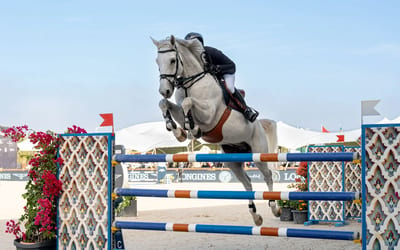
A German sport horse from Lower Saxony, registered with the Hannoveraner Verband - the largest warmblood studbook in the world. 160-173cm, powerful, elastic and bred for dressage and showjumping.
They carry the distinctive H brand on the near hindquarter, and every registered horse has papers recording its pedigree, inspection scores and performance results.
Founded on the state stud at Celle in 1735, established by George II to provide cavalry and agricultural horses. The studbook opened in 1888.
After mechanisation the programme was redirected toward sport, with Thoroughbred and Trakehner blood added for refinement. The selection system - stallion licensing, performance testing, mare inspection and grading - is what produced the modern horse and is the breed's real product.
160-173cm, 550-700kg. A large frame with good bone, a well-set neck, a sloping shoulder and powerful hindquarters. Elastic, ground-covering movement.
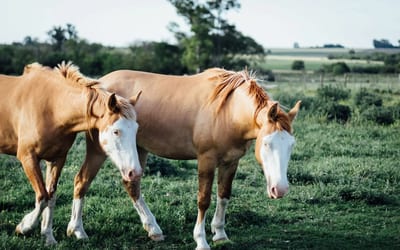
Chestnut, bay, brown, black and grey.
Rideability is an explicit selection criterion and it shows: Hanoverians are typically willing, straightforward and tolerant of pressure. They are forward without being sharp.
They are also large, powerful and athletic, and a young one is a great deal of horse for an amateur.
Bred for trainability. They learn quickly, cope with repetition better than a Thoroughbred, and hold their work. They reward correct riding and expose poor riding quickly.
They mature slowly - often not fully developed until seven - which is worth remembering against the commercial pressure to compete four- and five-year-olds.
An experienced adult's horse. Size, power and value all argue against a novice rider.
Usually easy on the ground, having been professionally handled from birth, and fine in a herd.
Osteochondrosis (OCD). The most common finding on a pre-purchase radiograph in warmbloods: cartilage fragments in the hocks and stifles, strongly associated with rapid growth and heavy feeding of youngstock. Many horses are sound with it, which is why the radiographs and a vet's interpretation matter more than a yes-or-no answer.
Warmblood Fragile Foal Syndrome (WFFS). A recessive connective tissue disorder; affected foals are born with fragile skin and do not survive. Carriers are healthy and the DNA test is straightforward. Two carriers must never be bred together, and the carrier rate across warmblood populations is meaningful.
Hock and stifle arthritis with work. Kissing spines, over-represented in sport horses. Gastric ulcers in horses in hard work.
Daily turnout, ridden work six days a week, legs felt by hand daily. Farrier every five to six weeks, shod all round for most. Teeth, vaccinations and worm counts as standard.
Most are on part or full livery.
Clipped in winter and rugged to match, groomed daily in work. Back and saddle checked by a qualified fitter twice a year and after any change in condition.
Very high and structured: schooling, hacking, jumping and fitness work six days a week for a competing horse. They need the work and they hold condition well.
Controlled work for youngstock. The joints are the limiting factor.
Forage first, conditioning feed matched to the work, a balancer, electrolytes in the season. Grow youngstock slowly: fast growth on heavy feed is directly implicated in OCD.
£10,000-£30,000 for a competent competition horse, £40,000-£200,000+ for a proven performer. Unbacked three-year-olds from £6,000.
Keeping one costs £6,000-£15,000 a year on part or full livery before competition expenses.
Ask for the Verband papers and check the brand and microchip against them. The paperwork is the point of buying a Hanoverian rather than a warmblood type, and it records the pedigree, the inspection scores and the performance results.
Ask for the WFFS carrier status, particularly if you might breed.
Five-stage vetting with a full radiographic set - hocks, stifles, front feet - from your own vet. Expect to find something; the question is what your vet makes of it.
Ask about kissing spines and any back treatment history, and ride the horse twice on separate days.
No Hanoverians are advertised at the moment. Save this search and an email goes out when one is listed.
A shortlist rarely has one name on it. These sit closest to the Hanoverian on size, coat and temperament, and each one has a full guide.
Going to see a Hanoverian? Take the horse and pony checklist with you. It is the questions worth asking while you are stood in somebody's kitchen, rather than on the drive home.