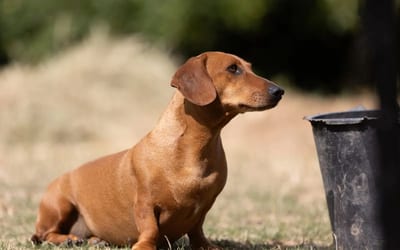
Dachshund
A short-legged scent hound with an outsized personality and one serious structural…
A small, long-backed scent hound with an enormous personality and one health problem that dominates everything else: roughly one in four will have a disc episode in their lifetime, and how you keep them changes the odds.

We do not have enough Miniature Dachshund adverts yet to publish a price range from our own data. The figures in the price section below are an editorial estimate.
Scores are editorial, and describe the breed in general. Individual animals vary, and how a dog is bred and raised matters more than its breed.
Ask to see the certificates, with the parents' registered names on them. "Parents health tested" in an advert means nothing on its own.
A scaled-down Dachshund, under 5kg, bred to go to ground after rabbits as the standard size went after badgers. Long body, short legs, deep chest, and one of three coats: smooth, long-haired or wire-haired. Each coat behaves slightly differently, and the wire in particular carries more terrier in its temperament.
They are one of the most popular dogs in Britain and have been for a decade. They are also a shape the Kennel Club now watches, because the proportions that made them good at their job are the same proportions that put their spine under strain.
Developed in Germany from the 16th century as a badger dog - Dachs badger, Hund dog. The miniature was bred down deliberately in the 19th century for rabbit work, where a smaller dog could follow into tighter burrows. They arrived in Britain with Prince Albert and were fashionable by the 1870s. The breed nearly vanished here during the First World War for the obvious reason.
Under 5kg, 13-18cm at the shoulder, with a body roughly twice as long as it is tall. The chest is deep with a pronounced keel. Smooth coats are short and glossy; long-haired have feathering on the ears, chest and legs; wire-haired have a harsh topcoat with a beard and eyebrows. Red and black-and-tan are commonest, with dapple, brindle and cream also seen.
Double dapple is a pattern to avoid buying. Breeding two dapples together produces dogs that are frequently deaf, blind or both, and it is done because the coats sell.
Bold out of all proportion to their size, affectionate with their own household, and reserved with strangers. They were bred to go into a hole in the ground and face an angry badger alone, and that independence is still there. A Dachshund that has decided something is rarely talked out of it.
They bark. It is a deep bark for the size and they use it on the postman, the doorbell and anything in the garden. Training moderates it; nothing removes it.
Clever and entirely capable of learning, but not biddable in the way a retriever is - they were bred to work out of sight of the handler and make their own decisions. Short, food-led sessions work. Repetition and insistence do not.
House training is the commonest complaint about the breed and the usual cause is a small dog with a small bladder being given the run of a large house too early. Crate or pen, take them out often, and expect it to take longer than you have been told.
Good with children who have been shown how to handle them, which for this breed specifically means never picking them up under the front legs and never letting them jump off furniture. A child who lifts a Dachshund badly can hurt its back. Ramps onto the sofa are worth having.
Usually fine with other dogs and with cats they have grown up with. Small pets are a different matter - this is a hunting breed and a rabbit in a hutch is not a friend.
Intervertebral disc disease. The one that matters. Roughly a quarter of Dachshunds have a clinical disc episode, ranging from pain and reluctance to move through to sudden hind-limb paralysis needing emergency surgery. The breed's long back and its cartilage type are both involved, so it is not something exercise alone prevents.
What shifts the odds: keeping the dog lean, banning jumping on and off furniture and stairs, harness rather than collar, and buying from parents that have been back-screened under the DachsLife or a comparable scheme. Ask for the scores. Many breeders do not have them.
cord1 PRA, a late-onset inherited blindness, with a DNA test. Lafora disease in wire-haired lines, a form of epilepsy, also DNA testable. Patella luxation, and dental disease, which small dogs get and Dachshunds get early.
Two short walks, a lead check, and a look at how they are moving. A Dachshund that is reluctant to jump up, yelps when lifted, or is walking with a hunched back needs a vet the same day, not on Monday. Early IVDD treated early does far better.
Teeth brushed most days. Weight checked monthly - a heavy Dachshund is carrying that weight on the worst possible frame.
Smooth: a weekly rub over, and that is it. Long-haired: two or three brushes a week, more behind the ears and on the feathering, where mats form. Wire-haired: brushing plus stripping two or three times a year, hand-stripped for a correct coat or clipped if you do not mind it softening.
All three need ears checked weekly and nails kept short. Long nails change how the foot lands and that travels up the leg.
Less than people expect: two twenty to thirty minute walks suits an adult. Puppies should do substantially less. The rule that matters more than distance is no jumping and no stairs - carry them down, use ramps, and keep the running on the flat.
They are scent hounds and will follow a trail with total deafness to their name. Long lead in open country unless the recall is genuinely proof.
Measured, weighed, and less than you think. Dachshunds gain weight easily and every extra pound loads the spine. Feed to the ribs - you should feel them easily under a thin layer. Treats come out of the daily allowance, not on top of it.
£800-£1,800 from a health-tested breeder for a standard colour. Dapple, cream and "rare" colours are advertised higher, often £2,500 and up, and the premium buys nothing but the colour.
Insurance is where this breed costs. Expect £40-£90 a month for lifetime cover on an adult, and buy it: a single IVDD surgery is £4,000-£8,000 and many dogs need more than one.
Ask for the back scores of both parents, the cord1 eye test, and Lafora for a wire-haired. A breeder who health tests will produce the certificates without being pushed.
Do not buy a double dapple, and be wary of a dapple advertised alongside another dapple parent. Ask what colour both parents are and walk away if the answer is evasive.
See the mother, watch how she moves, and ask whether she or any of her previous litters have had back trouble. It is the single most useful question you can ask about this breed and the answer tells you a great deal about the honesty of the breeder as well.
No Miniature Dachshunds are advertised at the moment. Save this search and an email goes out when one is listed.
A shortlist rarely has one name on it. These sit closest to the Miniature Dachshund on size, coat and temperament, and each one has a full guide.
Going to see a Miniature Dachshund? Take the puppy and dog checklist with you. It is the questions worth asking while you are stood in somebody's kitchen, rather than on the drive home.