Labradoodle
Labrador crossed with Poodle. Friendly, biddable and low-shedding when the cross goes…
A Golden Retriever crossed with a Poodle. Friendly, bright and often a superb family dog - and a cross with no standard, so size, coat and temperament vary enormously between litters and even within one.

We do not have enough Goldendoodle adverts yet to publish a price range from our own data. The figures in the price section below are an editorial estimate.
Scores are editorial, and describe the breed in general. Individual animals vary, and how a dog is bred and raised matters more than its breed.
Ask to see the certificates, with the parents' registered names on them. "Parents health tested" in an advert means nothing on its own.
A first-generation or later cross between a Golden Retriever and a Poodle, usually a Standard or Miniature. It is not a breed, it is a cross, and there is no standard - which means two Goldendoodle puppies from different litters can be genuinely different dogs.
Generations are described as F1 (Golden x Poodle), F1b (F1 back to a Poodle, so more Poodle and usually less shedding), F2 (two F1s) and onwards. F1b is the most predictable for coat; F2 is the least predictable of all.
The Labradoodle came first, bred in Australia in 1989 for allergy-friendly guide dog work. The Goldendoodle followed in North America in the 1990s on the same reasoning, with the Golden Retriever chosen for its softer, more biddable temperament.
The cross has never been recognised by the Kennel Club and there is no closed studbook, which is both why the variability exists and why breeder quality is the single biggest factor in what you get.
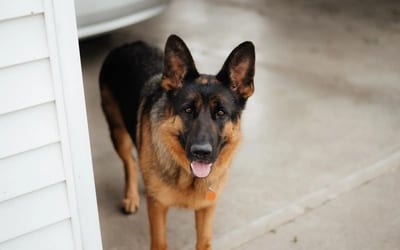
Anywhere from 15kg to 40kg and 43-61cm, depending on whether the Poodle parent was Miniature or Standard. Coats range from flat and Retriever-like through wavy to tight curls, and the shedding follows the coat: flatter coats shed, curly coats do not.
Cream, apricot, red, black and parti-colour. Nobody can tell you at eight weeks exactly what coat an F1 puppy will have as an adult.
Usually excellent. Both parent breeds are friendly, people-focused and biddable, and the cross generally inherits that. Goldendoodles are typically sociable with strangers, children, dogs and cats, and they want to be involved in everything.
They are not guard dogs. A Goldendoodle will show a burglar where things are kept.
The Poodle side brings more energy and more mental sharpness than people expect from the Golden Retriever half.
Very high on both sides, and it shows. They learn quickly, want to work, and do well at obedience, agility and scent work. They are widely used as therapy and assistance dogs for exactly this reason.
An untrained Goldendoodle is a bored, bouncy, mouthy adolescent, and that adolescence runs long - often to two years.
One of the better crosses for a family. Patient, tolerant and enthusiastic. The caveat is size and bounce: a 30kg dog that greets people by jumping needs teaching not to before it is 30kg.
Good with other dogs and usually with cats.
A cross is only as healthy as the testing behind both parents. Hybrid vigour is real but it is not a substitute for screening, and every condition below is carried by one or both parent breeds.
Hip and elbow dysplasia from both sides. Both parents must be scored.
Progressive retinal atrophy (prcd), DNA testable, in both breeds.
Von Willebrand disease, a bleeding disorder, from the Poodle side. DNA testable.
Ichthyosis, a skin condition, from the Golden Retriever side. DNA testable.
Cancer. The important one. Golden Retrievers have among the highest cancer rates of any breed - haemangiosarcoma and lymphoma particularly - and that risk crosses. It is the commonest cause of death in Goldendoodles too.
Bloat, being deep chested. Hypothyroidism. Addison's disease from the Poodle side.
Real exercise, training, brushing, and company. They are sociable dogs that do poorly alone all day.
The thing owners most underestimate.
A curly or wavy coat does not shed, which means the dead coat stays in and mats, particularly behind the ears, in the armpits, around the collar and on the back legs. Brush and comb to the skin three or four times a week and book professional grooming every six to eight weeks at £55-£90 a visit, for the dog's whole life.
A coat allowed to mat has to be shaved off, which is uncomfortable for the dog and upsetting for the owner. Groomers see it constantly.
High. Ninety minutes to two hours a day for a standard-sized adult, with off-lead running and something to think about. Miniature crosses need somewhat less but not dramatically so.
Controlled exercise while growing - they are slow to mature and the joints need protecting.
A good quality food matched to size and activity, measured, twice daily with rest either side for bloat. They are food-motivated from both sides and gain weight easily once neutered.
£1,500-£3,000, often more than either purebred parent, which is worth pausing on: you are paying a premium for a cross with no standard and no breed club oversight.
Grooming is £400-£700 a year. Insurance £45-£90 a month, and worth having given the cancer figures.
Ask for the health tests on both parents separately - hips, elbows, eyes, and the DNA panels for each breed. This is where most doodle breeding falls down: the cross is sold on the idea that mixing solves health, and it does not.
Ask what generation the puppies are. If low shedding matters to you, F1b is the safer bet and even then it is not guaranteed.
Do not buy on "hypoallergenic". No dog is. The allergen is a protein in saliva and dander, and plenty of people react to Poodle crosses. If allergy is the reason you are choosing this cross, spend an hour with an adult Goldendoodle first.
Ask the adult weights of both parents so you have some idea what you are getting.
No Goldendoodles are advertised at the moment. Save this search and an email goes out when one is listed.
A shortlist rarely has one name on it. These sit closest to the Goldendoodle on size, coat and temperament, and each one has a full guide.
Going to see a Goldendoodle? Take the puppy and dog checklist with you. It is the questions worth asking while you are stood in somebody's kitchen, rather than on the drive home.